-
Issuers approved for the program will receive written authority to use "digital collateral" for a limited number of securitizations.
 July 20
-
Mortgage rates continued their slide, with the conforming 30-year fixed at its closest point ever to breaching the 3% mark, according to Freddie Mac.
 July 9
-
Mortgage rates reached their lowest level this week since Freddie Mac began its Primary Mortgage Market Survey in 1971, but they might not have yet gotten to their floor.
July 2
-
Contract signings to purchase previously owned homes surged in May by the most on record as mortgage rates fell and some states began to reopen from coronavirus lockdowns.
June 29
-
Even as interest rates remained at record-low levels, mortgage application activity for both purchases and refinancings declined compared to one week earlier, according to the Mortgage Bankers Association.
June 24
-
Potential sales last month rose compared with April as homes became more affordable due to low mortgage rates.
 June 18
-
Purchase mortgage application volume was at its most in over a decade as consumer confidence continued to improve in the aftermath of the coronavirus shutdown, according to the Mortgage Bankers Association.
June 17
-
Mortgage rates increased slightly for the second consecutive week, buoyed early on by positive economic news such as the jobs report that came out last Friday, according to Freddie Mac.
June 11
-
Mortgage applications increased 2.7% from one week earlier, as purchase volume is now outpacing the prior year's activity, according to the Mortgage Bankers Association.
May 27
-
With mortgage rates reaching all-time lows in the opening quarter, refinance originations were up in 97% of housing markets during 1Q, according to Attom Data Solutions.
 May 21
-
Purchase mortgage activity rose for the third consecutive week, although the total volume was flat compared with the previous seven-day period, according to the Mortgage Bankers Association.
May 6
-
Mortgage rates fell to their lowest level since Freddie Mac started reporting this data in 1971, as the coronavirus shutdown continued to play havoc with the economy.
April 30
-
The coronavirus disruption caused March's pending home sales to fall and the losses will reverberate through the rest of 2020, according to the National Association of Realtors.
April 29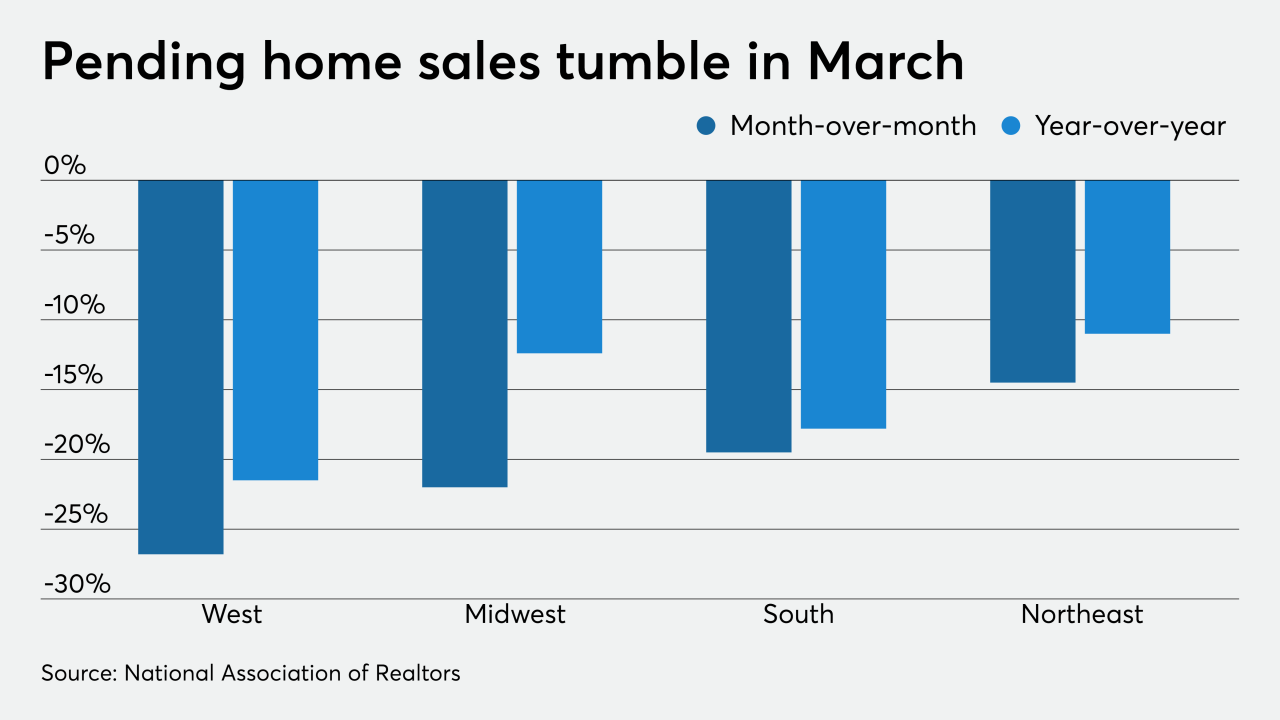
-
Lenders that split their sales of loans and servicing between two different investors may be facing yet another challenge due to the coronavirus outbreak.
April 13
-
Additional mortgage-backed securities purchases by the Federal Reserve Bank of New York will address private investor skittishness about the asset class, but it will not necessarily lower rates.
March 20
-
With small businesses feeling the financial scourge of the coronavirus, bridge loans could be the direction they turn to keep things afloat.
March 17
-
Increased refinancing volume led Fannie Mae to raise its 2020 estimate by $300 billion and 2021 projection by $280 billion.
March 12
-
Not so long after Treasury bond yields experienced an unprecedented drop, the average 30-year mortgage rate rose, reflecting volatility related to the coronavirus as well as capacity issues on multiple levels.
March 12
-
Mortgage companies that borrow heavily to keep their operations running may face financial pressure from coronavirus-related market volatility as it affects the valuations of collateral securing their financing.
March 9
-
Mortgage lenders could benefit from the surge in refinancing due to widening market spreads, and that could help offset damage to servicing rights portfolio valuations, according to Keefe, Bruyette & Woods.
March 9


