-
Now that the Consumer Financial Protection Bureau says it will scrap an unpopular standard for so-called qualified mortgages, the big question is what will take its place.
 February 2
-
Nonbanks hold a disproportionate percentage of the worst-rated loans, but banks hold a majority of the market, and risk management safeguards are largely untested, according to an interagency report on shared national credit.
 January 31
-
The agency has named Thomas G. Ward as the bureau’s assistant director for enforcement. House Democrats have questioned Ward's role as a political appointee in the Trump administration.
January 30
-
In another rollback of the bank trading ban, the federal agencies unveiled a plan to allow financial institutions to invest in multiple companies through certain fund structures.
January 30
-
Historically low interest rates, low unemployment and positive yet slowing economic growth will support stable U.S. structured finance asset performance in 2020.
January 28
-
The six bills championed by Democrats aim to reduce consumer burdens and provide opportunities for borrowers to rehabilitate their credit, but the legislation has garnered no Republican support.
January 28
-
To guard against headwinds in the agricultural sector, the Federal Deposit Insurance Corp. recommended that institutions consider the “overall financial status” of farm loan borrowers.
January 28
-
In the past, the agency cited the legal term in enforcement actions without stating what it meant, but Director Kathy Kraninger has sought to give the industry clearer guidance.
January 24
-
Democratic lawmakers, state attorneys general and others filed briefs with the Supreme Court rebutting claims that the agency’s leadership structure is unconstitutional.
January 24
-
Regulators already finalized a rollback of the proprietary trading ban section of the rule but signaled then that their overhaul was not finished.
 January 23
-
Trade associations representing mortgage lenders and securities market participants are asking the Federal Housing Finance Agency to rethink a plan to restrict pooling options for loans sold into uniform mortgage-backed securities.
 January 23
-
Nearly $1.2 trillion in speculative-grade debt is now set to mature between 2020-2024, including $750 billion in leveraged loans.
January 23
-
With interest rates expected to stay low while wages and the overall economy grow in conjunction, Fannie Mae again boosted its single-family mortgage origination outlook for 2019, 2020 and 2021.
 January 22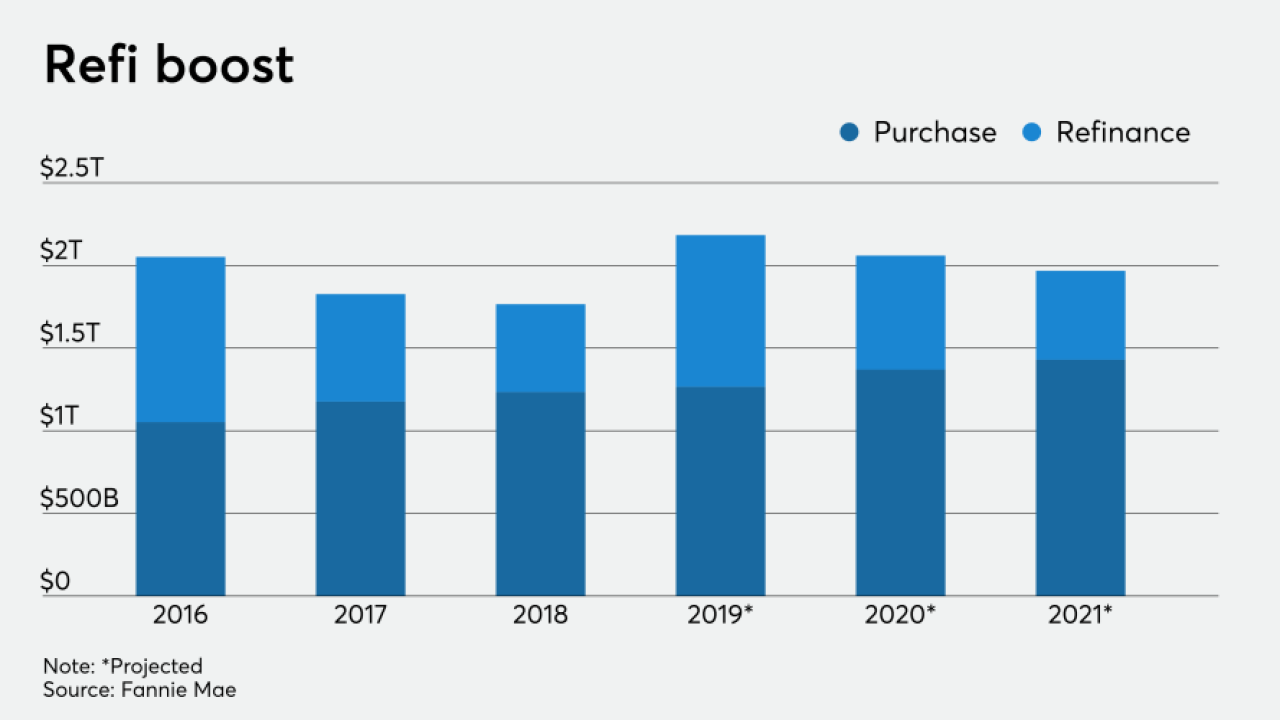
-
The Federal Housing Finance Agency is considering bringing back the idea of imposing stricter criteria for purchasing mortgages in areas where residential Property Assessed Clean Energy financing is available.
January 21
-
The $430.2 million PSMC 2020-1 transaction is a pool of 602 large-sized loans with an average loan balance of $715,978, all of which meet CFPB's QM standards.
January 21
-
The agency is sending a strong message that it won’t rush to end an exemption for Fannie Mae and Freddie Mac while also signaling longer-term changes that will affect all lenders.
January 21
-
Director Kathy Kraninger has told lawmakers that the agency will delay the expiration of the so-called QM patch, now set for January 2021.
January 21
-
In another sign of state officials trying to outdo the Consumer Financial Protection Bureau, governors in California and New York want greater authority to license and oversee the debt collection industry.
January 15
-
The Supreme Court appointed Paul Clement to represent the agency after the bureau’s current director questioned its constitutionality.
January 15
-
Fannie Mae is sponsoring a $1.03B CRT transaction, while Caliber Homes Loans, New Residential and Onslow Bay fill the non-QM pipeline
January 14


