
Regulation and compliance
Regulation
-

The Trump administration has installed Jeffrey Clark at the Consumer Financial Protection Bureau. Clark, a former environmental lawyer in the Justice Department in the first Trump administration, was indicted as part of the president's efforts to overturn the 2020 election.
February 17 -

The consortium of businesses intends to work with state regulators to protect consumers as interest from secondary market investors also grows.
February 14 -

The White House has tapped former Federal Deposit Insurance Corp. Director Jonathan McKernan to lead the Consumer Financial Protection Bureau and attorney Jonathan Gould to lead the Office of the Comptroller of the Currency late Tuesday.
February 11 -
The government-sponsored enterprises were not meant to remain in conservatorship permanently, but privatizing them once again must include a new set of rules that minimize market disruptions and maximize their focus on making homeownership affordable.
February 11 -

The Federal Reserve governor said regulators have stifled the banking system's ability to experiment with emerging technologies.
February 5 -

Treasury Secretary Scott Bessent, who was named to be acting director of the Consumer Financial Protection Bureau, has told the agency's staff to put a halt to all rules, enforcement actions and hiring.
February 3 -

The Consumer Financial Protection Bureau's Rohit Chopra in a letter to President Donald Trump confirmed that his "term as CFPB Director has concluded."
February 1 -

Experts say the Trump administration is waiting for Scott Bessent to be confirmed as treasury secretary and for other appointees to clear the Senate before naming acting heads at federal banking agencies.
January 24 -

Sunsetting the federal oversight of Fannie Mae and Freddie Mac could ease the cost of renewing President Trump's 2017 tax act, but doing so is an uphill battle.
January 21 -

A one-page outline of priorities for Trump's inauguration day obtained American Banker includes financial policy items, including firing Consumer Financial Protection Bureau Director Rohit Chopra, issuing a "reset" of that agency and designating crypto as a "national priority."
January 20 -

Leftover goals from the first administration of president-elect Donald J. Trump 1.0 could shake MBS and other ABS sectors.
January 17 -

Commoditization of mortgages, plus technology that eases the refinance process, and the regulatory environment, all contributed to the decision.
January 17 -

The agency wants the National Collegiate Student Loan Trusts, which sell student loan asset-backed securities (ABS) to investors, to pay $2.25 million in fines to borrowers.
January 17 -
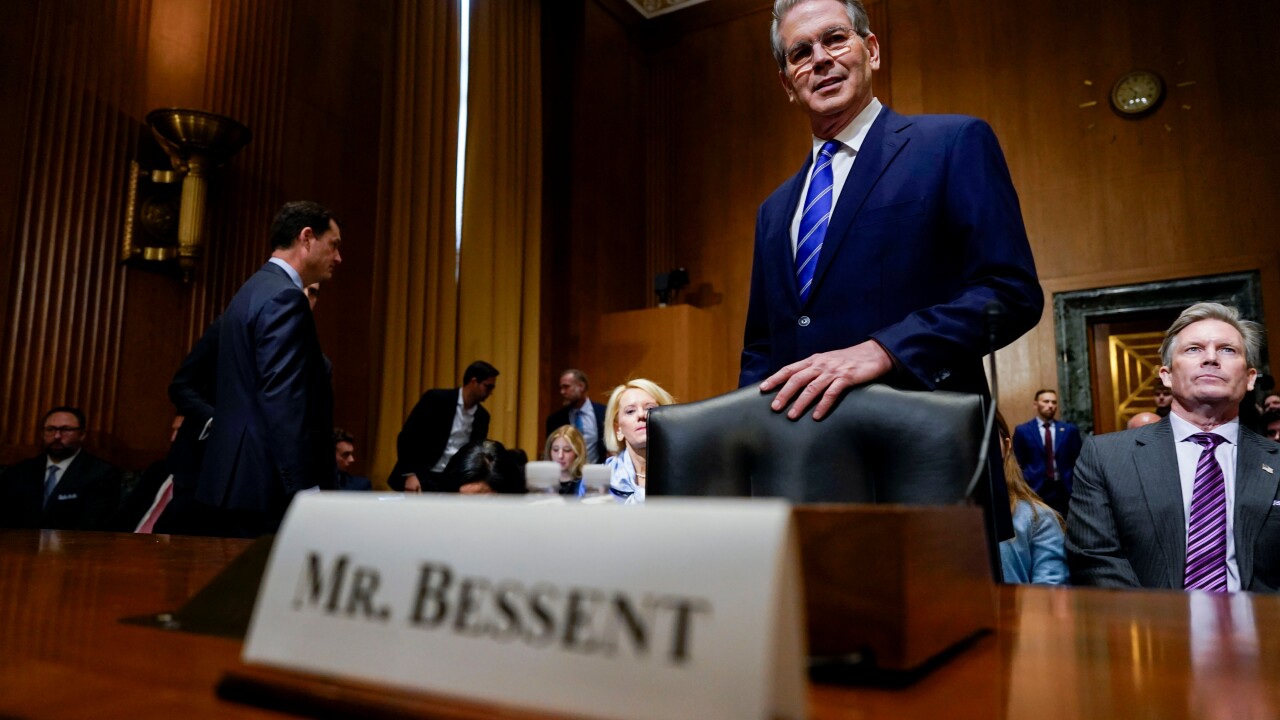
Scott Bessent, Donald Trump's pick to serve as Treasury Secretary, handled a policy-heavy confirmation hearing with poise, highlighting his preference for relaxed bank regulation, support of the 2017 Trump tax cuts and a hawkish approach to spending.
January 16 -
The incoming Trump administration's 'agency review team' has landed and is expected to name an acting director of the Consumer Financial Protection Bureau. Republicans on the Federal Deposit Insurance Corp. or the Federal Trade Commission are among the most likely candidates.
January 15 -
The Consumer Financial Protection Bureau's research found that the majority of buy now/pay later users are subprime borrowers, holding high credit card balances and multiple loans, suggesting the offering is riskier to lenders than previously assumed.
January 13 -

A cohort of bank industry interest groups called for the incoming Trump administration to pause all pending bank regulation and litigation and extend the timelines for implementing final rules issued by the Biden administration.
January 13 -

Seen by many as a logical pick for the Federal Reserve's next vice chair for supervision, Gov. Michelle Bowman wants the institution to focus on safety and soundness issues, tailoring and transparency.
January 9 -

Consumer Financial Protection Bureau's decision removes about $49 billion in medical bills from consideration for about 15 million Americans.
January 7 -

The Federal Reserve will seek comment on the current stress-testing regime with an eye toward increasing transparency and reducing volatility. Modifications would not go into effect until at least 2026.
December 23


