-
More consumer and commercial borrowers are paying their loans, increasing the likelihood that charge-offs will be manageable for banks despite the ongoing pandemic.
September 11
-
The Senate Banking Committee met Wednesday to review central bank lending facilities such as the Main Street Lending Program, which provides bank-issued loans to middle-market firms. But some lawmakers on the panel said the focus of pandemic relief has been misplaced.
 September 9
-
"The current economic crisis continues to disproportionately impact borrowers with FHA and VA loans," said Mike Fratantoni, the MBA's senior vice president and chief economist.
 September 8
-
An emergency expansion of federal rental assistance would cost between $12 billion and $16 billion a month, depending on whether enhanced unemployment benefits are extended alongside. That is a bargain in comparison with the $2.2 trillion price of the last coronavirus relief package.
September 8
-
The Federal Housing Finance Agency's proposal could undermine the companies’ mission to support the housing market and penalize consumers in underserved communities, industry and consumer groups say.
September 8
-
The agency’s plan to extend the "qualified mortgage" stamp of approval to more loans could help lenders that rely on alternative data and cushion the blow of other QM changes for Fannie Mae and Freddie Mac.
 September 2
-
The pandemic drives home the point that without those funds being siphoned off, the recent fee hikes would not be necessary.
September 2 Community Home Lenders Association
 -
This proposed Libor replacement is an imaginary, backward-looking benchmark dreamed up by the economists at the Fed with no discernible market.
September 2 Whalen Global Advisors LLC
 -
Individuals who received a coronavirus stimulus check earlier this year also qualify for the protection, as do couples who jointly file their taxes and expect to earn less than $198,000.
September 1
-
Following its deadline for written comments on the topic last month, the Federal Housing Finance Agency is scheduling events that will focus on two key themes emerging in responses.
 September 1
-
For the first time since June 7, the number of loans going into coronavirus-related forbearance didn't decrease from the week before, according to the Mortgage Bankers Association.
August 31
-
Arch's second CRT transaction this year to obtain indemnity reinsurance for mortgage-insurance premiums comes at a time it is also experiencing rising 60-plus-day delinquencies on its outstanding securitized pools.
August 31
-
Property-level insurance and funds fronted by servicers appear to mitigate the potential losses from damages and repairs in the Gulf Coast from the massive storm.
 August 28
-
Blackstone Group, which led Wall Street's initial foray into the single-family rental business, is making a new investment in suburban houses at a time when the COVID-19 pandemic is pressuring traditional commercial real estate.
August 28
-
The new reality for investors and originators accounts for forbearances and ability-to-repay.
 August 28
-
Both the Federal Housing Finance Agency and Federal Housing Administration are extending relief for homeowners and renters due to the pandemic crisis.
August 27
-
Party polarization and racial equity issues make it tougher for trade groups to manage internal divisions while ensuring the field supports those who get their hands on the levers of power.
August 27
-
Mortgage application volume decreased 6.5%, falling for the second consecutive week with refinance activity at its lowest since early July, according to the Mortgage Bankers Association.
 August 26
-
If it makes landfall as a Category 3 storm as was initially projected, damage from Hurricane Laura's surge could potentially devastate 432,810 residential properties in Texas and Louisiana, according to CoreLogic.
August 25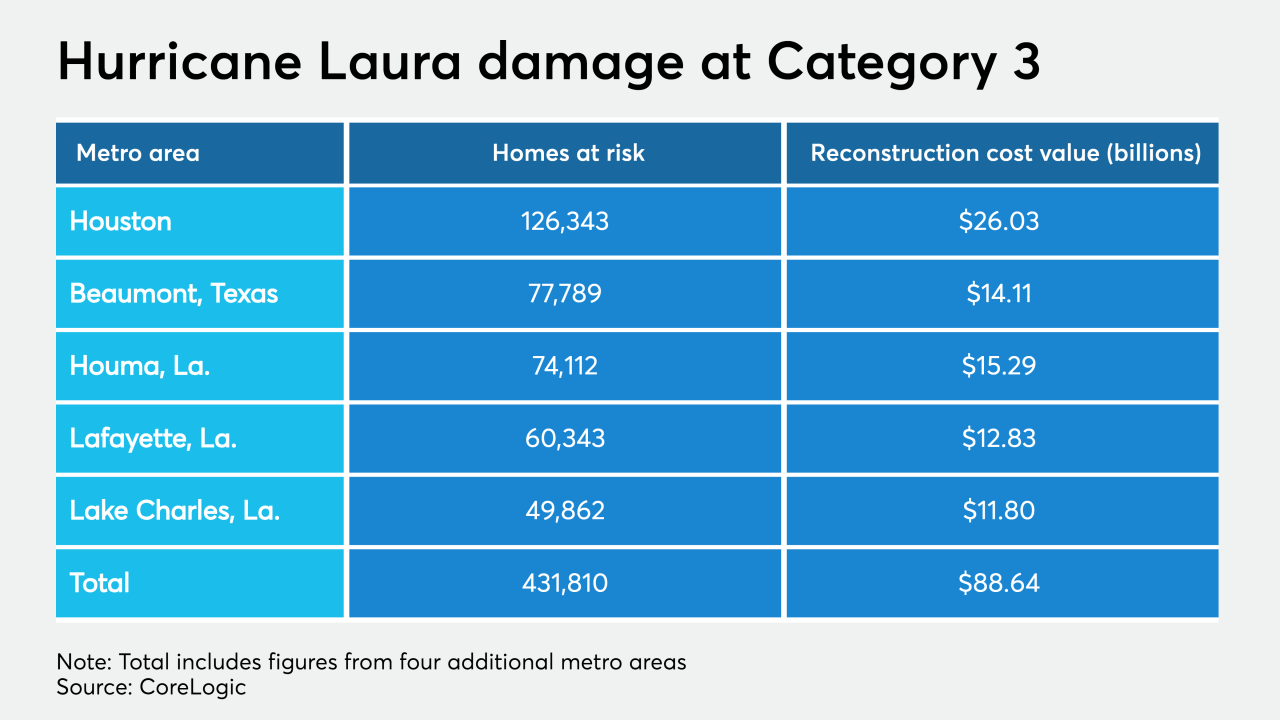
-
The mortgage giants were criticized earlier this month for a plan to charge an "adverse market fee" to protect against losses resulting from the pandemic.
August 25


