
Regulation and compliance
Regulation
-

As lawmakers tackle Fannie Mae and Freddie Mac, any revamp must lessen risk to the mortgage system and U.S. taxpayers.
October 21 -

The high court will decide how much latitude a president has to fire the director of an independent agency.
October 18 -

In her second day of congressional testimony, Kathy Kraninger took heat from Senate Democrats for weighing in on constitutional questions about her agency and for her enforcement track record.
October 17 -

CFPB Director Kathy Kraninger faced a barrage of questions from Democrats on the House Financial Services Committee over why the agency has not demanded refunds for consumers in recent settlements.
October 16 -

A list of upcoming cases published by the high court did not include a challenge to the bureau's constitutionality, but the justices could still decide to review it at a later date.
October 15 -

The reforms will result in significant changes to the proprietary trading ban first proposed by former Federal Reserve Chairman Paul Volcker and mandated in the Dodd-Frank Act.
October 8 -

The two Democrats waded into a court battle over the president's ability to fire a director of the Consumer Financial Protection Bureau.
October 8 -

The industry had welcomed the Consumer Financial Protection Bureau plan allowing debt collectors to use electronic communication, but some worry about the effect of a court decision concerning email correspondence.
October 7 -

Allowing the mortgage giants to retain profits resolves a short-term capital shortfall, but how much capital they would need after exiting conservatorship is still the bigger question.
October 4 -

Jelena McWilliams told community bankers that policymakers should be a resource for banks trying to adopt new technology.
October 1 -

By declaring that she has too much statutory power, the agency’s director has potentially opened a floodgate of litigation.
October 1 -

The move to alter the government's preferred stock purchase agreements is the first major one under FHFA Director Mark Calabria's tenure to wind down the conservatorship of the government-sponsored enterprises.
September 30 -
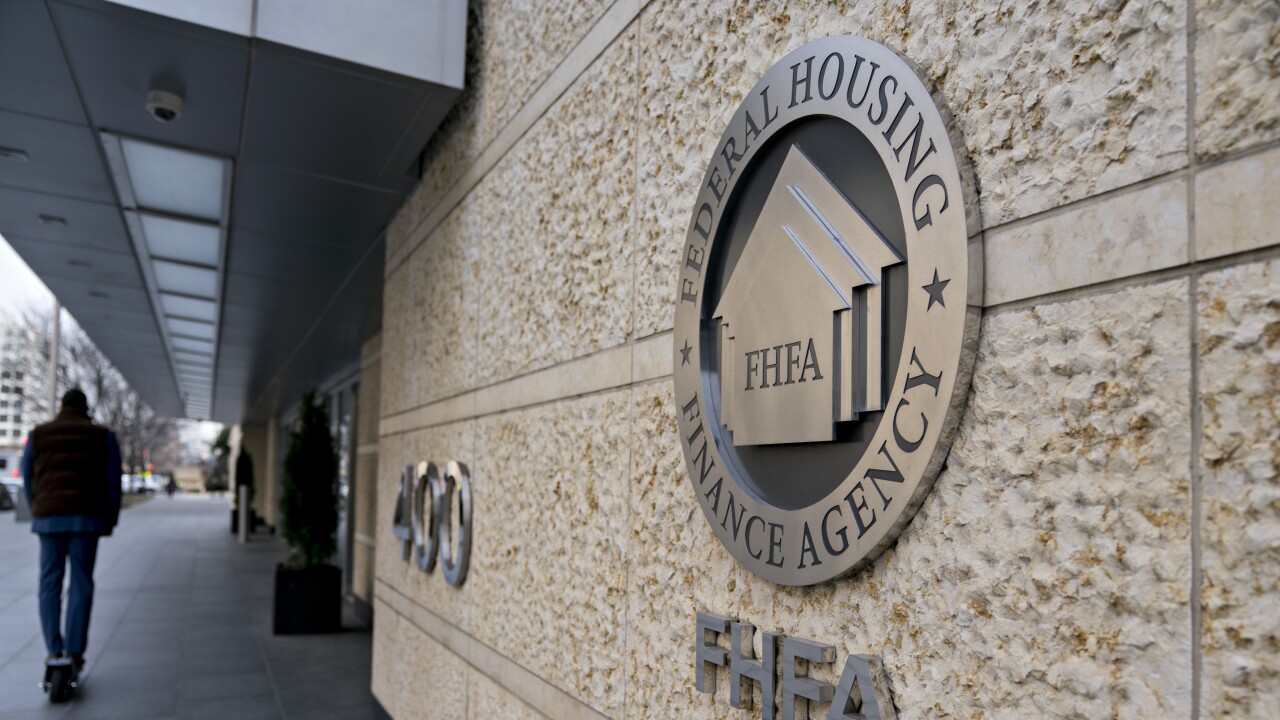
The shareholders' claims against Fannie Mae and Freddie Mac's regulator mirror arguments in cases challenging the Consumer Financial Protection Bureau.
September 26 -

A hearing on legislative proposals exposed a sharp partisan divide over a regulatory plan to restrict the frequency of collection calls.
September 26 -

Members of the House Financial Services Committee cited leveraged lending, cybersecurity and the switch to a new interest rate benchmark among potential systemic risks that keep them up at night.
September 25 -

If the court agrees to hear the case, its conservative majority could make it easier for a president to fire a CFPB director, though other outcomes are possible.
September 23 -
The recapitalization of Fannie Mae and Freddie Mac prior to the 2020 election is unlikely even if the net worth sweep ends, according to a Keefe, Bruyette & Woods report.
September 23 -

The proposed reforms of Fannie Mae and Freddie Mac have gotten all the attention, but the administration also wants to scale back the Federal Housing Administration, expand its capital cushion and adopt risk-based pricing. Some of the ideas have former agency officials concerned.
September 19 -

There were signs Kathy Kraninger would continue a rollback of consent orders and investigations, but many observers see an aggressive approach reminiscent of the Obama era.
September 18 -

The agency's director told congressional leaders and staff that she backs a Supreme Court challenge to the bureau's leadership structure.
September 17


