-
Almost all five A1 tranches benefit from credit enhancement levels of 26.10%. The A1A tranche, however, has a credit enhancement level of 36.10%.
 6h ago
-
New U.S. ABS sales have surpassed $300 billion for a third straight year, with issuance already 11% higher than it was at this point in 2025. Spreads are the narrowest in more than four years.
September 21
-
The deal's obligor concentrations—its top and top five obligors account for 9.45% and 37.95% of the pool—are reigned in by WEF's focus on mission-critical essential use equipment.
September 21
-
Ed Comber, a pioneer in music catalog securitization, also joined the firm as a partner in structured finance and securitization.
September 21
-
GDLP 2026-2 also has lower levels of initial credit enhancement compared to GDLP 2026-1, at 6.12% versus 5.74%; overcollateralization at 23.90% versus 24.92% and total gross excess spread of 5.55% versus 5.98%.
September 18
-
A two-part sale was reached in June. Yum China Holdings agreed to buy the China-based business for $1.2 billion, while LongRange acquired the rest for $1.5 billion.
September 18
-
To keep cash flowing to the notes, the deal's senior notes have an interest reserve account covering three months' worth of class A note interest payments and fees.
September 17
-
Classes A-1FCF through A-1F will repay noteholders on a pro rata basis, while classes A2 through B3 will be repaid sequentially.
September 17
-
The Elliot-backed manager doubles down on research and expertise to confront market challenges, including tight arbitrage and a looming 2028 debt maturity wall.
September 17
-
Most borrowers, 61.2%, fall within SoFi Bank's highest tiers 1 and 2, and they have a WA income of $156,504.That's an improvement from their earnings on SCLP 2026-3.
September 16
-
Classes A1 through A4 benefit from credit enhancement levels of 27.00%; while classes B, C and D benefit from credit enhancement levels of 22.75%, 18.25% and 13.50%, respectively.
September 15
-
ODAS IV 2026-1 will issue expandable term notes, so that at any time during the revolving period the issuer can periodically upsize the notes to a maximum of $626 million.
September 15
-
The series 2026-1, A-1-V and 2026-1, A-2, issued from a master trust, have an anticipated repayment date of September 2031.
September 14
-
Bank of America upped its forecast for non-qualified mortgage issuance, with investors, particularly insurers, buying these and other non-agency securities.
 September 14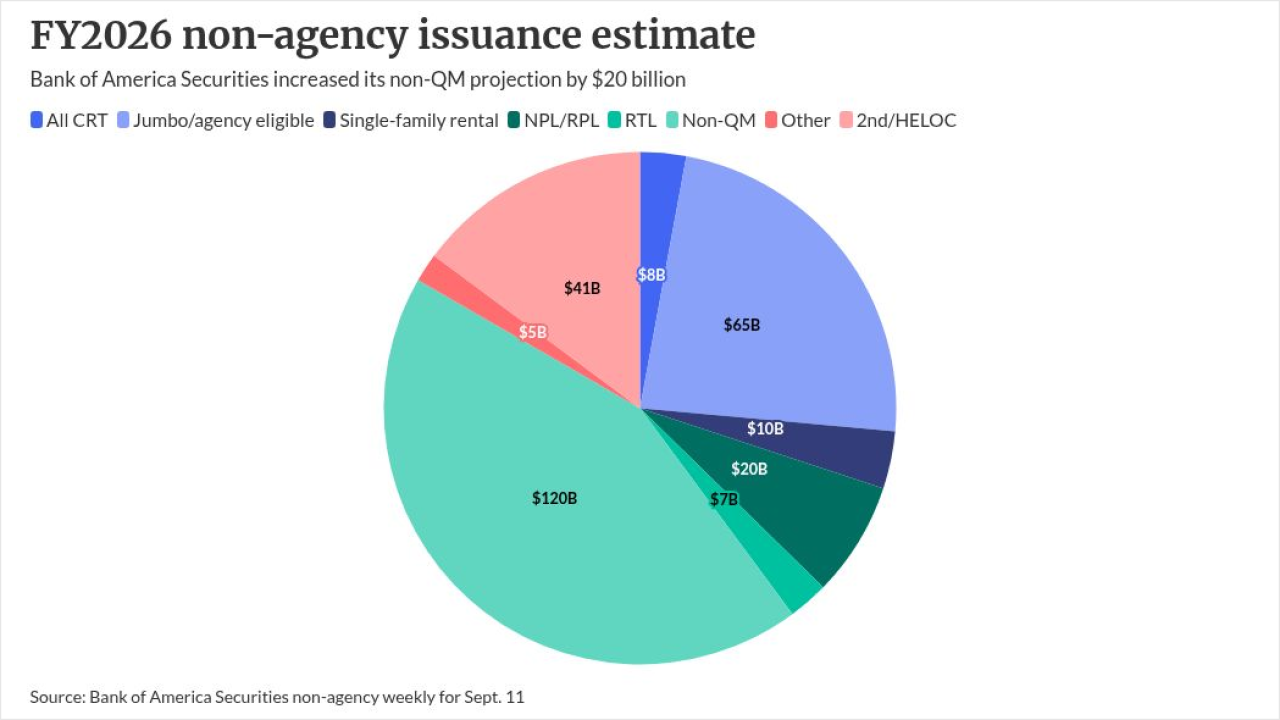
-
NHBFA's senior bonds benefit from credit support levels ranging from 17.00% to 19.70%, based on its 'AA' stressed break-even cash flow.
September 11
-
S&P's base-case loss assumption on the deal is 4.75%, with a 'AAA' rating stress loss assumption of 30%, with losses increasing to that level over 12 months.
September 11
-
The current transaction has the largest collateral pool that the platform has issued all year, with 294 loans, and it has the highest percentage of conforming loans, at 45.1%.
September 10
-
If a cumulative net loss ratio amortization event occurs, then Reach 2026-3 will enter full turbo mode, a phase when the transaction will use all available funds to sequentially pay down the outstanding notes.
September 10
-
The series AFRMT 2026-4 and AFRMT 2026-5 have virtually identical capital structures, but have legal final maturity dates of Sept. 17, 2035, and Sept. 15, 2037, respectively.
September 9
-
The 2026-B notes have a total initial hard credit enhancement of 10.00%, compared with 9.60% from the previous deal, the 2026-A.
September 8