-
As lawmakers tackle Fannie Mae and Freddie Mac, any revamp must lessen risk to the mortgage system and U.S. taxpayers.
October 21 Mortgage Bankers Association
 -
The reforms will result in significant changes to the proprietary trading ban first proposed by former Federal Reserve Chairman Paul Volcker and mandated in the Dodd-Frank Act.
 October 8
-
The industry had welcomed the Consumer Financial Protection Bureau plan allowing debt collectors to use electronic communication, but some worry about the effect of a court decision concerning email correspondence.
 October 7
-
Allowing the mortgage giants to retain profits resolves a short-term capital shortfall, but how much capital they would need after exiting conservatorship is still the bigger question.
October 4
-
The move to alter the government's preferred stock purchase agreements is the first major one under FHFA Director Mark Calabria's tenure to wind down the conservatorship of the government-sponsored enterprises.
September 30
-
The shareholders' claims against Fannie Mae and Freddie Mac's regulator mirror arguments in cases challenging the Consumer Financial Protection Bureau.
September 26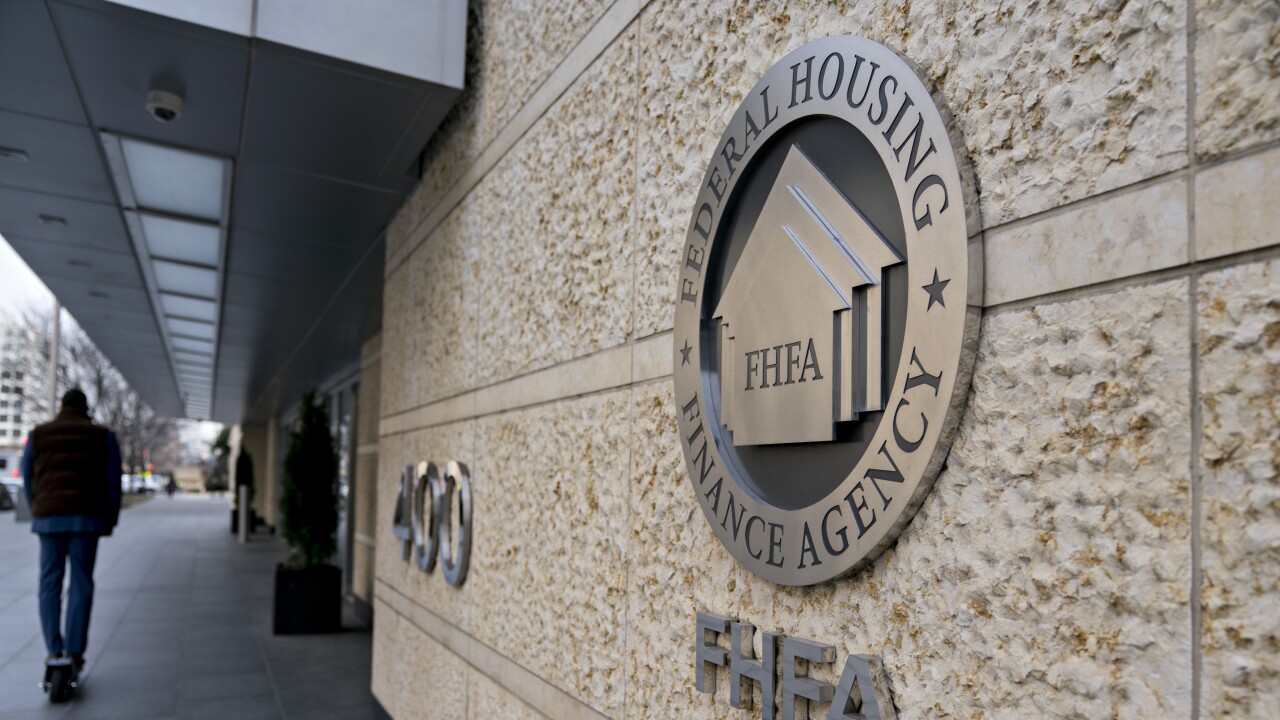
-
A hearing on legislative proposals exposed a sharp partisan divide over a regulatory plan to restrict the frequency of collection calls.
September 26
-
The recapitalization of Fannie Mae and Freddie Mac prior to the 2020 election is unlikely even if the net worth sweep ends, according to a Keefe, Bruyette & Woods report.
 September 23
 -
The proposed reforms of Fannie Mae and Freddie Mac have gotten all the attention, but the administration also wants to scale back the Federal Housing Administration, expand its capital cushion and adopt risk-based pricing. Some of the ideas have former agency officials concerned.
September 19
-
The regulator for Fannie Mae and Freddie Mac suggested that a finalized capital framework for the two mortgage giants could be published by the end of the year.
September 11
-
The bureau issued three policies removing the threat of legal liability for approved companies that test new products.
September 10
-
The Treasury secretary said he hopes lawmakers will back reforms of Fannie Mae and Freddie Mac within three to six months.
September 9
-
The Trump administration raised the goal posts for ending the conservatorships of Fannie Mae and Freddie Mac, but how officials get there is still highly uncertain.
September 6
-
The Treasury Department made clear in a much-anticipated report that it prefers Congress take up reform of the government-sponsored enterprises, but it also recommended steps that federal agencies could take without legislation.
September 5
-
With officials putting finishing touches on presidentially directed reports on the future of the housing finance system, the Senate Banking Committee announced a hearing to examine the issue.
September 4
-
The mortgage industry will be looking for answers when Treasury and HUD unveil reports on housing finance reform, but the Trump administration’s plans could also raise a whole new host of questions.
August 29
-
Though advocates and industry are rarely aligned, they are starting to coalesce around a plan that would call for the elimination of the CFPB’s 43% debt-to-income limit as part of its qualified mortgage rule.
August 27 -
The agencies handed banks a significant victory when they finalized revisions to the Dodd-Frank proprietary trading ban, but officials also plan to re-propose changes to the “covered funds” section of the rule.
August 25
-
After two regulatory agencies adopted final revisions to the rule, Dodd-Frank defenders expressed concern that the amendments to the proprietary trading ban undermined the post-crisis statute.
August 20
-
The agencies had proposed an "accounting prong" as an alternative means to determine which proprietary trades are banned, but their final rule heeded industry concerns that that would be worse than the current approach.
August 20


